145-224 135-224 145-226 145-237 145-239 135-239 117LV-237 117LV-239 125-237 135-229 125-224 135-226 135-237 117LV-229 117LV-226 125-229 125-226 117LV-224 135-229 145-229

Pro-Set Inc.
P.O. Box 656
707 Martin St.
Bay City, MI
48706-0656

888-377-6738

Standard Laminating Epoxies

The chart compares the viscosity and cure speed of the various resin and hardener combinations.  When you select a particular combination on the chart, the technical datasheet will automatically open.  You can also use the list on the left side of the page to choose the resin/hardener combination of interest and open the technical data sheet.

PRO-SET Laminating Epoxies are formulated for the manufacture of lightweight, high-performance composites of glass, aramid, carbon fiber or hybrids, using contact molding, vacuum bag and resin infusion procedures. They bond to all fabrics, core materials, wood and metal. Through the use of a compatible tie coat, PRO-SET Laminating Epoxies can be used with in-mold gelcoats to provide a full range of composite capabilities.

PRO-SET Laminating Epoxies are formulated to yield an increased crosslink density in the epoxy matrix for superior heat resistance and moisture-exclusion effectiveness, with excellent fatigue and toughness properties. Extensive fatigue testing and infield use have demonstrated that PRO-SET Laminating Epoxies produce lightweight structures with an exceptional ability to withstand cyclic loading in harsh environments.

PRO-SET Laminating Epoxies not only provide the necessary mechanical and thermal properties for high-performance composites, they are formulated to meet a wide range of process requirements for the composites manufacturing industry. PRO-SET Laminating Epoxies consist of four resins of different viscosity and four hardeners with different cure speeds, that can be combined to create different epoxy mixtures to meet a range of manufacturing process requirements. Each resin/hardener combination has its own unique handling characteristics, cure schedules and physical properties.

In addition to the basic range of handling characteristics provided by the primary resin/hardeners combinations, some resins and hardeners give you the option of making custom resin or hardener blends. That is, you can mix two different resins or two different hardeners together to achieve intermediate properties, so long as the proper resin to hardener ratio is maintained. See the resin and hardener descriptions for information on which products are compatible for blending. With the exception of 117LV Resin mixtures, Laminating Epoxies are compatible with roller-type impregnating machines for controlled impregnation of most reinforcement materials at the optimum resin-to-fiber ratio.

For some resin/hardener combinations, a room temperature cure will be sufficient for many applications, while others require an elevated temperature cure or post-cure. However, with optimum post-curing, all PRO-SET Laminating Epoxies develop 100% of their potential physical properties. Higher Heat Deflection Temperatures (HDT) are reached by post-curing, resulting in reduced print through even under dark-colored surfaces. Even moderate post curing develops higher fatigue resistance and mechanical strength.

Resin/Hardener Selection

In some situations, the selection of a resin/hardener combination is determined by the need for specific mechanical or thermal properties for a finished part. In most situations, however, the choice of resin/hardener combination is determined by the handling characteristics required for a particular manufacturing process. There are three basic composite manufacturing processes:

In Contact molding, or open molding, the wet-out laminate cures in the mold at ambient atmospheric temperature and pressure -- nothing covers the laminate. Fiber and core can be wet out outside of the mold by hand or impregnator, or in the mold by hand or with a flow coater.

Vacuum bagging is a closed mold process in which the laminate is compressed under atmospheric pressure to reduce resin content and eliminate voids. Fiber and core may be wet out in or out of the mold. A vacuum bag, placed over the wet-out laminate, is sealed to the mold flange and a vacuum pump draws air from under the vacuum bag. Atmospheric pressure squeezes the laminate between the bag and the mold surface until the laminate is cured. The laminate can be cured at ambient or elevated temperature.

Resin infusion, or vacuum assisted resin transfer molding (VARTM), is a closed mold process that also uses the vacuum bagging technique to compress the laminate. But, in this process dry laminate is placed in the mold and wet out after the vacuum is applied. After the air is evacuated from the vacuum envelope, resin is allowed to flow through ports in the vacuum bag into the laminate stack. This method offers easier handling and fitting of the dry materials in the mold, and the increased compaction produces a laminate with low resin content.

When selecting a resin/hardener combination for one of these processes, consider these handling characteristics:

  • Viscosity of the resin/hardener combinations. Select a resin with a viscosity suited to application equipment and fabric weave and weight.
  • Open time and pot life needed. Select a hardener that provides adequate open and cure time based on the ambient temperature in the work area.
    • (View COMPARISON OF VISCOSITY AND POT LIFE for the different Resin/Hardener Combinations.)
  • Ability to cure at elevated temperatures. Select a combination that provides desired physical properties within the limitations of your post-cure capabilities or design post-cure equipment around the desired physical properties and resin/hardener combination.
    • (View GENERAL DESCRIPTIONS of Resin/Hardener Combinations or individual Technical Data sheets for information about cure requirements.)

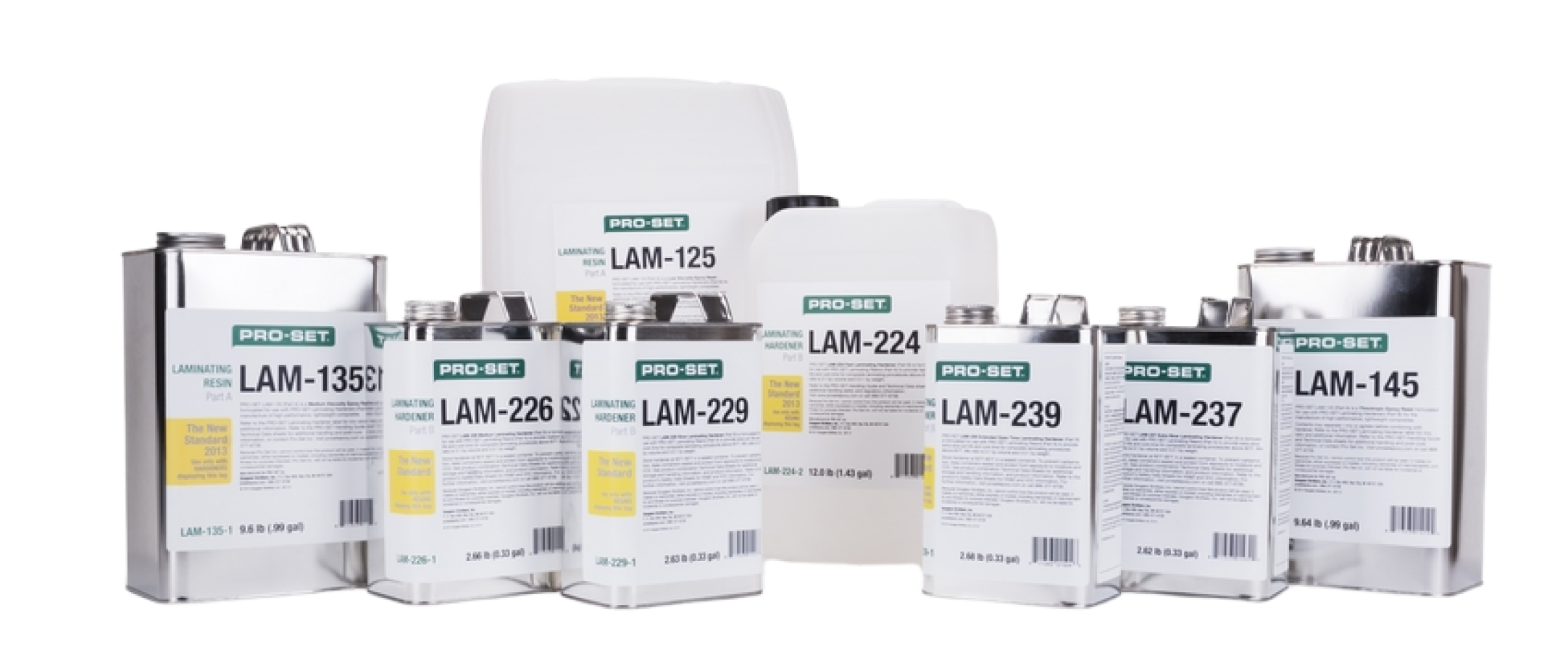
The following are general descriptions of PRO-SET Laminating Resins and Hardeners. Detailed handling characteristics and cured physical properties for each of the resin/hardener combinations are listed on separate technical data sheets. Read this sheet and the data sheets carefully to help you select the resin/hardener combination that will best suit your needs.

Resins

Each PRO-SET Laminating Resin is formulated with a different viscosity, intended to accommodate the variables of different applications. All resin/hardener mixtures maintain excellent working properties until gel takes place. The cure time will vary based on the hardener selected, ambient temperature and laminate thickness. Elevated temperature cure or post-curing is required for some combinations to pass through a brittle "B" stage and temper. Post-curing will increase mechanical properties and high-temperature performance.

117LV Infusion Resin

PRO-SET 117LV Infusion Resin is a very low viscosity resin that provides fast and thorough wetting of laminate. 117LV Resin is formulated with higher flow characteristics than any other PRO-SET Resin and is intended specifically for resin infusion processes. PRO-SET 117LV Infusion Resin mixtures should be post cured before demolding the part.

125 Resin

PRO-SET 125 Resin is a low viscosity resin that provides fast and thorough wetting of the laminate fibers. The low viscosity 125 Resin mixtures are ideal for working with thick fiber weaves and bundles, and result in a cured laminate with a higher fiber-to-resin ratio. Can be blended with 145 resin.

135 Resin

PRO-SET 135 Resin has an intermediate viscosity (between 125 and 145 Resins) that, when mixed with the appropriate PRO-SET Hardener, will provide thorough wet out of laminate fibers.

145 Resin

PRO-SET 145 Resin is a medium viscosity resin, ideal for vertical draping applications where minimum drain off is desired. 145 Resin mixtures work well with a roller-type impregnating machine, however, the higher viscosity of 145 Resin makes hand wet-out slower. With post curing, components made with PRO-SET 145 Resin have the potential to achieve a higher Heat Deflection Temperature and Glass Transition Temperature than components made with the PRO-SET 125 Resin. Can be blended with 125 Resin.

226 Hardener

PRO-SET 226 Hardener is mixed with PRO-SET Resins to provide medium pot life and cure time. 100g pot life at 72°F (22°C) is approximately 37 minutes with 125 Resin, 24 minutes with 135 Resin, and 32 minutes with 145 Resin. Post-cure heat -- 110°F to 180°F (43°C to 82°C) will accelerate the cure and improve the physical properties of the cured epoxy, and is required with 145 Resin mixtures to reach an acceptable degree of cure. Can be blended with 229 Hardener.

229 Hardener

PRO-SET 229 Hardener is mixed with PRO-SET Resins to provide long pot life and cure time. 100g pot life at 72°F (22°C) is approximately 110 minutes with 117LV Infusion Resin, 77 minutes with 125 Resin, 59 minutes with 135 Resin, and 67 minutes with 145 Resin. Post-cure heat -- 110°F to 180°F (43°C to 82°C) will accelerate the cure and improve the physical properties of the cured epoxy, and is required with 145 Resin mixtures to reach an acceptable degree of cure. Can be blended with 226 Hardener.

237 Hardener

PRO-SET 237 Hardener is mixed with PRO-SET Resins to provide very long pot life and cure time. 100g pot life at 72°F (22°C) is approximately 281 minutes with 117LV Infusion Resin, 180 minutes with 125 Resin, 115 minutes with 135 Resin, and 155 minutes with 145 Resin. Elevated temperature cure or post-cure at 125°F to 180°F (51°C to 82°C) will increase the degree of cure and improve mechanical properties and high-temperature performance, and is required with all resin mixtures to reach an acceptable degree of cure. Can be blended with 239 Hardener.

239 Hardener

PRO-SET 239 Hardener is mixed with PRO-SET Resins to provide extra long pot life and cure time. 100g pot life at 72°F (22°C) is approximately 465 minutes with 117LV Infusion Resin, 360 minutes with 125 Resin, 146 minutes with 135 Resin, and 240 minutes with 145 Resin. Elevated temperature cure or post-cure at 125°F to 180°F (51°C to 82°C) will increase the degree of cure and improve mechanical properties and high-temperature performance, and is required with all resin mixtures to reach an acceptable degree of cure. Can be blended with 237 Hardener.


  HOME :: STANDARD PRODUCTS :: CUSTOM PRODUCTS :: SAFETY :: NEWSLETTER :: TECH INFO :: CONTACT

(c) 2006 Pro-Set Inc.          Modified: July 25, 2006